Amogh Mannekote
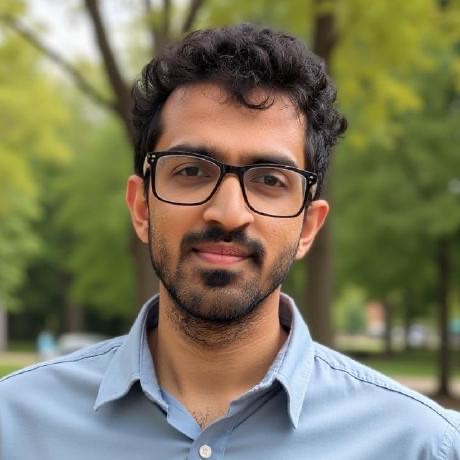
Portrait of Amogh Mannekote

LLM behavioral simulation

AmoghMannekote

Applied Research Scientist, Openstream.aiPh.D., University of Florida

I build language-model simulations of human behavior that hold up at the population level, so that researchers can run studies on simulated people when recruiting real ones is the bottleneck.

Uncalibrated
behavioral measure simulated agents, n = 180
Illustration. Each dot is one simulated agent. Calibration moves the simulated population onto a behavioral target measured in real people (dashed line), rather than tuning any single agent in isolation.
01

About

My PhD in Computer Science at the University of Florida, advised by Kristy Boyer and Bonnie Dorr, developed generative agent-based models of learners and calibrated them to population-level behavioral targets through test-time compute allocation.

My current work trains models against those behavioral targets directly with reinforcement learning. Before and during the PhD, I worked on task-oriented dialogue and synthetic data generation at Amazon Alexa, Openstream.ai, and Rasa.

02

Research program

A simulated population is useful as a scientific instrument only if its aggregate behavior matches what real populations do. My work treats that match as the objective: I measure where LLM simulations of people diverge from human behavior, calibrate them at inference time, and train models so that the calibration becomes a property of the model.

A · Fidelity

Belief-behavior consistency

Role-playing agents can describe how a persona will behave and then simulate it doing something else. In LLM simulations of human trust, models' stated predictions about a persona do not reliably match the behavior they generate for it, so a simulation's self-report cannot substitute for behavioral validation.

B · Calibration

Calibration as test-time compute allocation

My dissertation holds the generator and the target specification fixed and asks how inference-time compute should be distributed across a simulated population. Across fifty behavioral targets for simulated pair programming, whether a target is defined per session or over the whole batch predicts both its difficulty and which allocation strategy works.

Dissertation, 2026
C · Authoring

Simulating learners from composable hypotheses

HYP-MIX lets education researchers specify learner behavior as combinations of testable hypotheses and checks whether LLM-simulated learners stay behaviorally calibrated when those hypotheses are modified. It is the framework the learner-simulation work in my dissertation builds on.

D · Training

Training against behavioral targets

Search at inference time can make a population hit its targets, but it pays that cost on every run. My current work moves the objective into training and uses reinforcement learning to optimize models directly against population-level behavioral targets.

Current work
03

Publications

  1. COLM 2025

    Do Role-Playing Agents Practice What They Preach? Belief-Behavior Consistency in LLM-Based Simulations of Human Trust

    Amogh Mannekote, Adam Davies, Guohao Li, Kristy Elizabeth Boyer, ChengXiang Zhai, Bonnie J. Dorr, Francesco Pinto

    Conference on Language Modeling (COLM), 2025

    personatrust → P1P2P3P4 stated simulated gap
    Schematic · stated belief vs. simulated behavior
  2. AAAI 2025

    Can LLMs Reliably Simulate Human Learner Actions? A Simulation Authoring Framework for Open-Ended Learning Environments

    Amogh Mannekote, Adam Davies, Jina Kang, Kristy Elizabeth Boyer

    Proceedings of the AAAI Conference on Artificial Intelligence (AAAI), 2025

    H1 H2 H3 LLMlearner hypothesessimulatoractions vs. target
    Schematic · composable learner hypotheses
  3. COLING 2025

    IndirectRequests: Making Task-Oriented Dialogue Datasets More Natural by Synthetically Generating Indirect User Requests

    Amogh Mannekote, Jinseok Nam, Ziming Li, Jian Gao, Kristy Elizabeth Boyer, Bonnie J. Dorr

    Proceedings of the 31st International Conference on Computational Linguistics (COLING), 2025

    direct Book a table for two at seven. indirect Any chance a place has roomfor two of us around seven? same intentreserve(party=2, time=19:00)
    Illustrative example · same intent, indirect form

All other publications

  1. 2024Journal

    Large Language Models for Whole-Learner Support: Opportunities and Challenges

    A. Mannekote, A. Davies, J. D. Pinto, S. Zhang, D. Olds, N. L. Schroeder, B. Lehman, D. Zapata-Rivera, C. Zhai. Frontiers in Artificial Intelligence 7, 2024.

  2. 2024Preprint
  3. 2024Conference

    Examining LLM Prompting Strategies for Automatic Evaluation of Learner-Created Computational Artifacts

    X. Tian, A. Mannekote, C. E. Solomon, Y. Song, C. F. Wise, T. McKlin, J. Barrett, K. E. Boyer, M. Israel. Educational Data Mining (EDM), 2024.

  4. 2024Preprint

    Can Similarity-Based Domain-Ordering Reduce Catastrophic Forgetting for Intent Recognition?

    A. Mannekote, X. Tian, K. E. Boyer, B. J. Dorr. arXiv:2402.14155.

  5. 2023Conference

    Exploring Usability Issues in Instruction-Based and Schema-Based Authoring of Task-Oriented Dialogue Agents

    A. Mannekote, M. Celepkolu, J. B. Wiggins, K. E. Boyer. ACM Conference on Conversational User Interfaces (CUI), 2023.

  6. 2023Preprint

    Agreement Tracking for Multi-Issue Negotiation Dialogues

    A. Mannekote, B. J. Dorr, K. E. Boyer. arXiv:2307.06524. Dataset

  7. 2023Preprint
  8. 2022Conference

    Don't Just Paste Your Stacktrace: Shaping Discussion Forums in Introductory CS Courses

    A. Mannekote, M. Celepkolu, A. C. Galdo, K. E. Boyer, M. Israel, S. Heckman, K. Stephens-Martinez. ACM Technical Symposium on Computer Science Education (SIGCSE), 2022.

04

Experience

  • 2026.10 –

    Applied Research Scientist, Openstream.ai

  • 2021 – 2026

    Graduate Research Assistant, University of Florida

    Gainesville, FL
  • 2024.09 – 12

    Research Intern, Amazon Alexa · MENTOR, in-context adaptation to feedback and tool-use instructions

    Bellevue, WA
  • 2023.09 – 12

    Research Intern, Openstream.ai · LLM semantic parsing for neuro-symbolic dialogue

    Remote
  • 2023.05 – 09

    Research Intern, Amazon Alexa · IndirectRequests

    Bellevue, WA
  • 2020

    Data Scientist, Fractal Analytics & Crux Intelligence · Text-to-SQL evaluation

    Bengaluru
  • 2019

    Machine Learning Solutions Architect, Rasa

    Berlin
  • 2018 – 2019

    Research Assistant, Robert Bosch Centre for Cyber-Physical Systems, Indian Institute of Science

    Bengaluru
  • 2018

    Intern, IBM Watson Machine Learning

    Bengaluru
  • 2017 – 2018

    Research Intern, Stride.AI

    Bengaluru

Education

  • 2021 – 2026

    Ph.D., Computer Science, University of Florida · Neurosymbolic Authoring and Test-Time Compute Allocation for Generative Educational Simulations

    Gainesville, FL
  • 2014 – 2018

    B.E., Computer Science & Engineering, Ramaiah Institute of Technology

    Bengaluru
05

News & artifacts

News

  • 2026.08

    Ph.D. in Computer Science conferred by the University of Florida for the dissertation Neurosymbolic Authoring and Test-Time Compute Allocation for Generative Educational Simulations.

  • 2026.10

    Joined Openstream.ai as an Applied Research Scientist to train models against behavioral targets.

  • 2025.10

    Belief-behavior consistency in role-playing agents appeared at COLM 2025.

  • 2025.02

    HYP-MIX appeared at AAAI 2025.

  • 2025.01

    IndirectRequests appeared at COLING 2025, with the dataset released on Hugging Face.

Research code & data

  • Code

    HYP-MIX · authoring and calibration framework for LLM learner simulations

  • Dataset

    IndirectRequests · indirect user requests for schema-guided dialogue

  • Dataset

    GPT-NegoChat · multi-issue negotiation dialogues with agreement-state annotations

  • Library

    nonechucks · PyTorch datasets and samplers that skip invalid samples

06

Outside research

I also design and build personal software with coding agents, such as Ratchet, an accountability timer with a cloud-synced goal tree.

Personal software

Correspondence

msamogh [at] gmail [dot] com

© 2026 Amogh MannekotePersonal software · Back to top